What the Law Actually Says
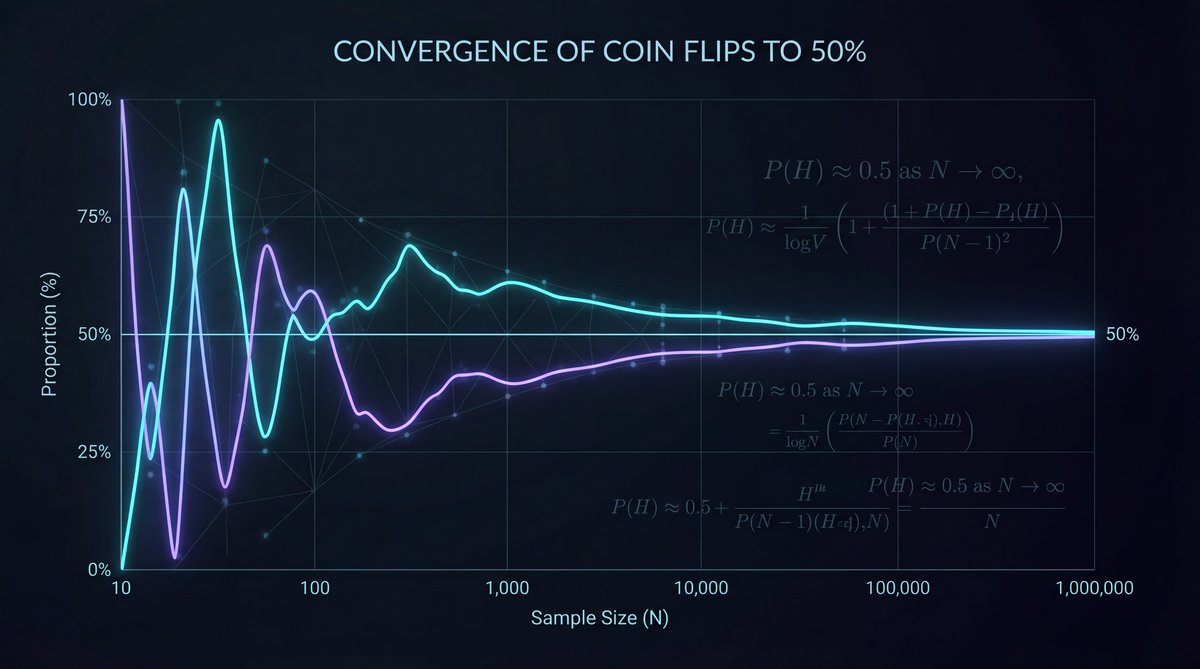
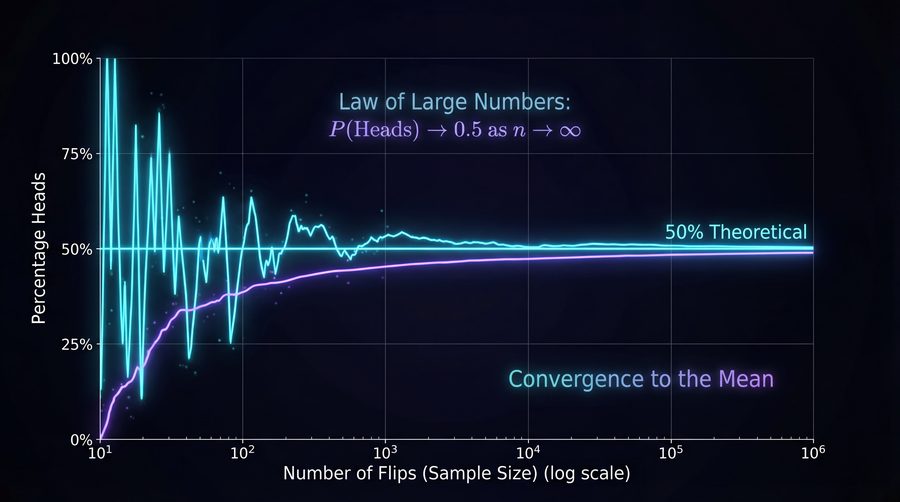
The Law of Large Numbers (LLN) is deceptively simple: as a sample size grows, its mean gets closer to the population mean — the expected value. Mathematicians distinguish between two versions: the weak law (probability converges) and the strong law (almost surely converges). For practical purposes, the insight is the same: bigger samples are more reliable.
But here's the crucial distinction that most people get wrong: the Law of Large Numbers is NOT the same as saying "things even out short-term." That's the gambler's fallacy, and it's a devastating misunderstanding. In the short term, variance is wild. You can flip a coin 10 times and get 8 heads. That doesn't mean the next 10 flips "have to" be mostly tails to balance it out. The Law of Large Numbers describes long-term behavior, not short-term compensation.
The law of large numbers doesn't make past events more or less likely. It simply says that, given enough trials, the average will converge to the expected value.
Why Casinos Always Win
Walk into any casino and you'll see people who think they can beat the odds. Some nights, they win. Some nights, they lose big. But the casino? The casino is utterly predictable. Not because the casino is lucky, but because the Casino understands the Law of Large Numbers in their bones — even if they don't know the mathematical name.
Every casino game has a house edge: European roulette has about 2.7%, American roulette has 5.26%, slot machines typically 2-15%. On a single bet, anything can happen. A gambler can get incredibly lucky. But here's what the casino knows: across millions of bets per day — across thousands of players, hundreds of tables — the house's revenue becomes nearly deterministic.
A single blackjack hand? Pure randomness. But 10,000 hands in an evening? The house's profit margin is almost as certain as gravity. The more bets placed, the more certain the house's profit. The individual gambler operates in high-variance territory where luck matters enormously. The casino operates in the low-variance territory of large numbers, where probabilities become certainties.
Insurance: Selling Certainty Using Uncertainty
Insurance companies face a paradox: they insure individuals against unpredictable events, yet their own business is remarkably predictable. How? The Law of Large Numbers.
An insurance company doesn't know if any single customer will get sick, have a car accident, or suffer property damage. For one person, the outcome is wildly uncertain. But with thousands of policyholders across a region, claims become highly predictable. Actuarial tables, mortality statistics, and carefully constructed risk pools all rely on this principle working in practice.
One car accident is unpredictable; 100,000 are extremely predictable. An insurance company can calculate almost exactly how many claims they'll receive in a given year, which is why they can confidently price premiums and still make a profit. This is also why diversification works in investing — individual stocks are volatile and unpredictable, but a diversified portfolio of hundreds of stocks converges toward market returns with remarkable consistency.
Political Polling and the Margin of Error
Here's a mind-bending fact: a poll of 1,000 people can represent 330 million Americans to within a margin of error of ±3%. How is that possible? The answer is the Law of Large Numbers, and it's more elegant than most people realize.
The accuracy of polling scales with the square root of sample size, not the total population. Double your accuracy and you need to quadruple your sample size. Triple your accuracy and you need nine times as many respondents. This explains why pollsters rarely use more than 1,000-2,000 respondents — the returns diminish rapidly. And it works regardless of whether the total population is 1 million or 1 billion.
But there's a critical caveat: this assumes a truly random sample. A random sample of 1,000 beats a biased sample of 1 million every single time. The 1936 Literary Digest poll is the classic cautionary tale. They surveyed 2.3 million people — an enormous sample by any standard — yet wildly mispredicted the election. Why? Because their sample was biased (they surveyed car owners and telephone subscribers, who skewed wealthy). Bias overwhelms the Law of Large Numbers. Randomness doesn't.
Where It Breaks Down: Black Swans and Fat Tails
The Law of Large Numbers is powerful, but it has limits. It assumes stable distributions — the kind where extreme events are rare and don't pull the average too far away.
Some phenomena have "fat tails," as Nassim Taleb famously discussed in his book "The Black Swan." Financial markets, earthquakes, pandemic spread, and conflict intensity don't follow normal distributions. In these domains, rare but extreme events don't average away — they dominate the outcome. The 2008 financial crisis is the perfect example: risk models assumed normal distributions, and assumed the Law of Large Numbers would smooth out volatility. They were catastrophically wrong because housing markets and credit correlations don't follow the bell curve.
The takeaway is crucial: the Law of Large Numbers is extraordinarily powerful, but first understand what distribution you're dealing with. For normally distributed phenomena, the law is nearly guaranteed. For fat-tailed distributions, extreme events are far more likely than the math suggests, and averaging breaks down. Know your data. Know your distribution. Then apply the law.