The Oldest Game: Knucklebones and Astragali
Before there were cubic dice, before there were standardized gaming rules, there were bones. Humans have been rolling bones for over 5,000 years — far longer than we've had written language to document it.
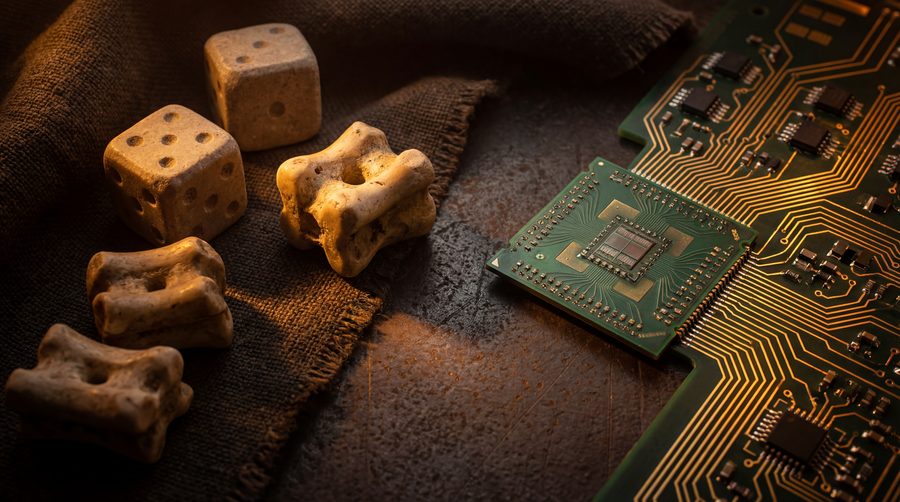
The earliest known dice are not cubes. They're astragali — the ankle bones of sheep and goats, naturally shaped into four-sided objects with two flat sides and two rounded sides. Archaeological evidence places astragali in use across ancient Egypt (dating to around 3000 BCE), Mesopotamia, and ancient Greece. These weren't just toys. Astragali were sacred objects used in religious divination — a way to let the gods speak through randomness. They were also used for gambling and competitive games, suggesting that humans have always understood that some outcome is determined by chance, not skill.
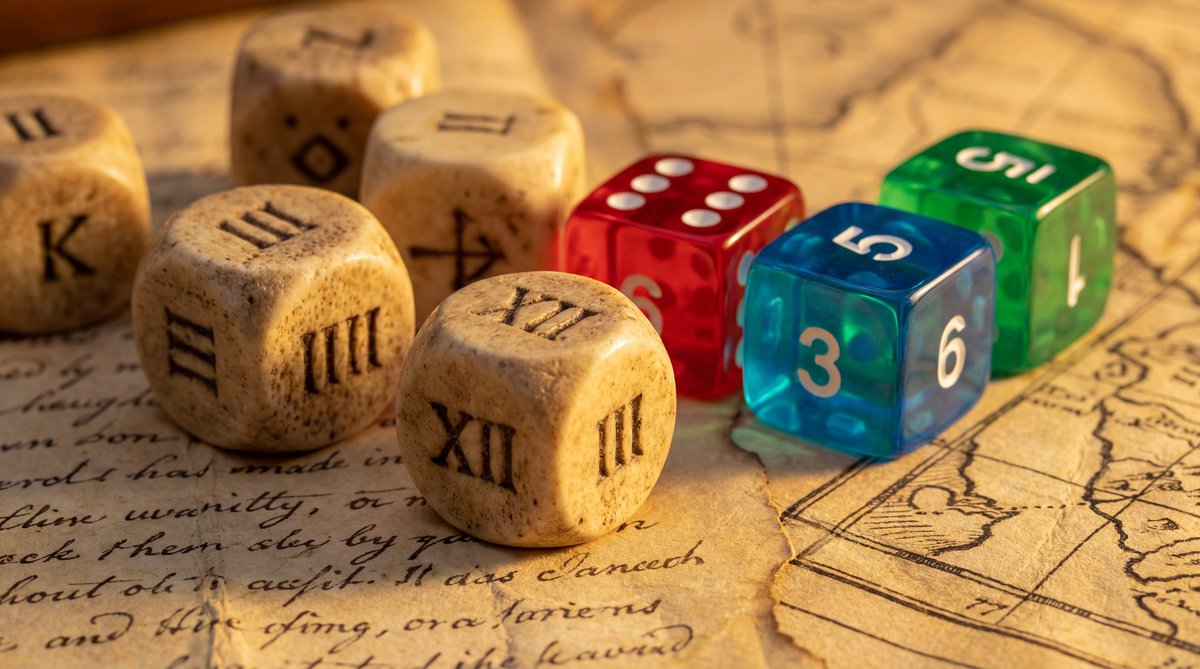
The transition from knucklebone to cuboid die happened gradually over centuries. Instead of relying on naturally-shaped bones, people began carving stones and bones into six-sided cubes. The oldest known cuboid dice were found at Shahr-e Sokhteh (Burnt City) in Iran, dating to approximately 2800-2500 BCE, discovered alongside a backgammon-like board game. These early cubic dice were roughly carved and hand-decorated. They marked a fundamental shift in human thinking: we could standardize randomness.
Dice in Ancient Rome and Greece — Cheating Included
The Romans didn't just accept dice as a game of chance. They became obsessed with gambling. Emperor Augustus famously played dice. Dice games were everywhere — in taverns, military camps, and the homes of wealthy patricians. Dice rolling became so culturally significant that it was used as a metaphor for irreversible action. Julius Caesar's legendary phrase, "alea iacta est" (the die is cast), spoken as he crossed the Rubicon and started a civil war, invoked the image of rolling dice — once thrown, the outcome is beyond your control.
Where there is gambling, there is cheating. Archaeologists have uncovered loaded dice at Pompeii and Roman sites across Europe. These plumbatae — lead-filled dice weighted to favor certain faces — prove that people 2,000 years ago understood the principle of probability well enough to cheat it. The Romans even had a term for someone caught cheating with dice: an "aleatores fullo" (cheating dice roller). The arms race between fair chance and human manipulation is ancient.
Greek philosophers were more intellectually suspicious of gambling than the Romans, but they were fascinated by the mathematics of chance. They asked the question that would, centuries later, spawn probability theory: How can randomness be measured and predicted? They didn't have the tools to answer it, but they asked the right question.
The Birth of Probability Theory — Pascal and Fermat
The modern mathematical study of probability didn't emerge from philosophy or pure mathematics. It emerged from a gambling dispute.
In 1654, a wealthy French nobleman named Chevalier de Méré posed a problem to mathematician Blaise Pascal. During a game of dice, the stakes had become quite large when the game had to be interrupted. How should the money be fairly divided between the two players, given the game was unfinished? Pascal realized this wasn't a question of luck or opinion — it was a mathematical problem. He corresponded with Pierre de Fermat about the problem, and together they developed the foundational concepts of probability theory: expected value, combinatorial analysis, and the law of large numbers.
What's remarkable is that Pascal didn't invent probability theory to solve abstract problems. He invented it to answer a practical question from a gambler. Their correspondence became the birth of a science that would eventually underpin statistics, insurance actuarialism, quantum mechanics, and machine learning. Pascal's Triangle (which is actually much older — it appears in work from India and China centuries earlier, but Pascal systematized its use for probability calculations) became the visual representation of how randomness unfolds over multiple trials.
"It is remarkable that a science which began with the consideration of games of chance should have become the most important object of human knowledge." — Pierre-Simon Laplace, 1812
The 20th Century: From Tables to True Randomness
For 250 years after Pascal and Fermat, probability theory developed as pure mathematics. But the 20th century brought practical applications that demanded actual random numbers, not just theory.
Before computers, mathematicians published books of random number tables. The most famous is the Rand Corporation's "A Million Random Digits," published in 1955 — a book that is literally just random numbers. It still sells on Amazon. Why? Because before you could ask a computer to generate random numbers, you had to publish a book of them.
Once computers existed, the challenge became: how do you generate random numbers from a deterministic machine? The answer is that you can't — not perfectly. John von Neumann's middle-square method (1946) was pioneering but deeply flawed. You'd take a number, square it, extract the middle digits, and feed it back in. The sequence looked random but had hidden patterns. Early computers also used Linear Feedback Shift Registers (LFSRs), which are fast but predictable.
The Mersenne Twister (1997, developed by Matsumoto and Nishimura) became the gold standard Pseudorandom Number Generator (PRNG) for decades. It's fast, has excellent statistical properties, and produces sequences that pass rigorous randomness tests. But it's still deterministic — if you know the seed and the algorithm, you can predict every number it will generate.
The move toward hardware randomness accelerated in the 2000s and 2010s. Intel's RDRAND instruction (introduced in 2012) brings direct hardware random generation to consumer processors. Instead of relying on algorithms, the processor accesses true randomness from physical quantum effects at the transistor level. This is the frontier where randomness stopped being a mathematical trick and became a physical property you could access directly.
Today: Quantum Randomness and Cryptographic Security
We now live in the quantum era of randomness. Quantum Random Number Generators (QRNGs) exploit quantum phenomena to generate numbers that are not just unpredictable algorithmically, but unpredictable in principle. They use photon path splitting (sending single photons through a beam splitter and detecting which path they take) or vacuum fluctuations (the quantum noise present in empty space). Phone manufacturers are embedding QRNG chips into consumer devices.
The Australian National University (ANU) has built an online service that generates real quantum random numbers from quantum vacuum fluctuations and serves them over an API. You can request random bits, and they'll give you numbers generated from actual quantum phenomena. The philosophical shift is profound: we've moved from manufactured randomness (dice, shuffling) to algorithmic randomness (computers) to harnessing randomness from the fabric of reality itself.
For security and cryptography, the standards are even higher. Cryptographic random number generators combine hardware entropy (actual randomness) with algorithms to produce random numbers that are both unpredictable and computationally secure. If someone could predict your random number generator, they could predict your encryption keys. This matters. TLS/SSL certificates (the security that protects your bank accounts and private messages), blockchain nonces (the security of Bitcoin and Ethereum), password salts (why the same password produces different hashes) — all rely on quality randomness. The entire internet's security infrastructure is built on random numbers.
The journey is staggering in scope: from knucklebones in ancient Egypt, to Roman soldiers cheating with loaded dice, to Pascal solving gambling disputes, to computers generating pseudorandom sequences, to quantum mechanics producing true randomness, to that randomness powering internet security and cryptography. Five thousand years, and we're still rolling the dice — except now the stakes are global, and the dice are quantum.